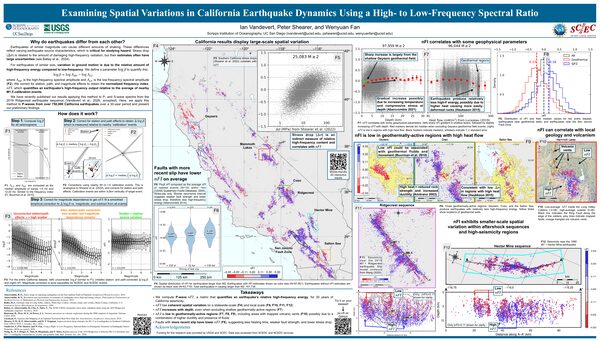
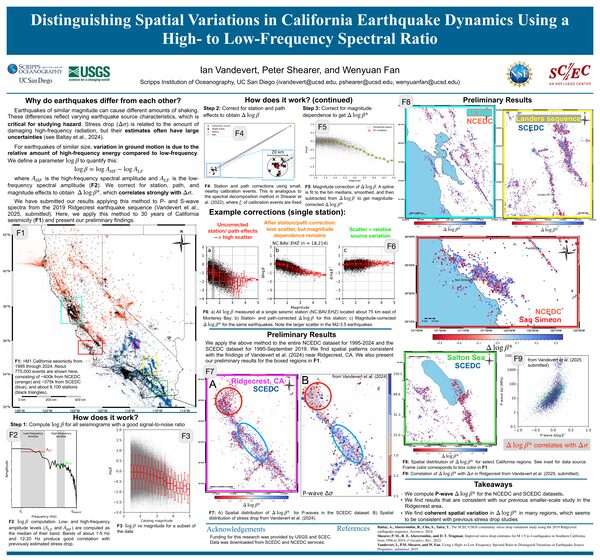
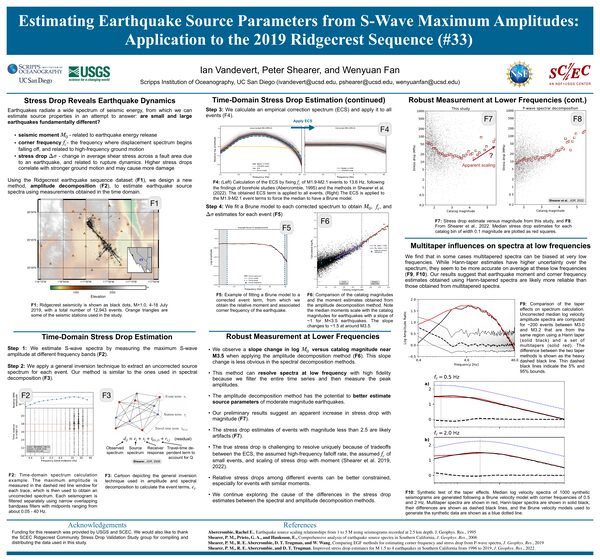
Earthquakes of similar magnitude produce different amounts of damaging high-frequency shaking. The spatial distribution of this variation is important for seismic hazard assessment and is often quantified indirectly using earthquake stress-drop estimates. For smaller earthquakes without surface deformation, stress drop must be inferred from an earthquake’s radiated seismic waves. This process is model-dependent, requiring assumptions about rupture geometry that are impossible to directly observe, so estimates of absolute stress drop can differ by an order of magnitude or more among different studies. Relative stress drop between events is more robust and can reveal which locations produce earthquakes with higher or lower stress drops, but such estimates remain tied to a source model. The normalized frequency index (nFI) instead directly quantifies the relative high-frequency enrichment of radiated waves. Here, we compute nFI values for 30 years of California seismicity to characterize spatial variations in high-frequency earthquake radiation. We find that nFI varies coherently on sub-10 km and larger scales and correlates with previous stress-drop estimates, albeit with scatter. Geothermal regions with high heat flow and areas with active volcanism systematically produce earthquakes depleted in high-frequency energy. Comparisons with other geophysical parameters reveal more complex relationships, indicating that no single mechanism controls high-frequency earthquake radiation across California.
@article{vandevert2026california,title={Distinguishing Spatial Variations in California Earthquake Dynamics Using a High- to Low-Frequency Spectral Ratio},author={Vandevert, Ian and Shearer, Peter M. and Fan, Wenyuan},journal={Journal of Geophysical Research: Solid Earth (submitted)},year={2026},month=jul,urldate={2026-07-18},}
BSSA
Using a High- to Low-Frequency Spectral Ratio to Distinguish Variations in Earthquake Source Properties
Ian Vandevert, Peter M. Shearer, and Wenyuan Fan
Bulletin of the Seismological Society of America, May 2026
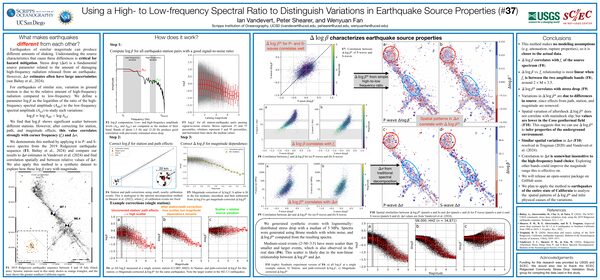
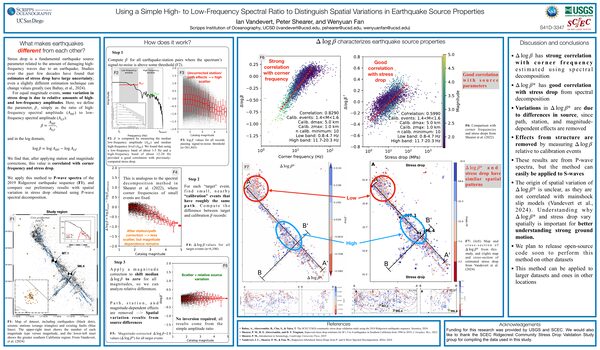
Earthquakes of similar magnitude can generate different amounts of high‐frequency radiation, contributing to variability in peak ground acceleration and uncertainties in ground‐motion prediction. These source differences are expressed in their P‐ and S‐wave spectra and affect spectral estimates of earthquake stress drop. Relative variations in spectra and related stress‐drop estimates among events are better resolved than their absolute values, and thus provide useful measurements for distinguishing earthquakes and their high‐frequency radiation content. Here, we quantify these differences in spectra using the frequency index (FI), defined as the logarithmic ratio of the average spectral amplitude in a high‐frequency band to that in a low‐frequency band. We then empirically correct for path and station effects to compute a new quantity, the normalized frequency index (nFI). We identify spatial variations in nFI values for aftershocks of the 2019 Ridgecrest earthquakes that correlate with published stress‐drop estimates. Our data‐driven approach can robustly identify variations in high‐frequency energy among different earthquakes and source regions, providing an observation‐based alternative to commonly applied stress‐drop estimation methods for characterizing source behavior at high frequencies.
@article{vandevert2026nfi,title={Using a High- to Low-Frequency Spectral Ratio to Distinguish Variations in Earthquake Source Properties},author={Vandevert, Ian and Shearer, Peter M. and Fan, Wenyuan},journal={Bulletin of the Seismological Society of America},year={2026},month=may,doi={10.1785/0120250171},urldate={2026-04-01},}
2025
BSSA
Overview of the SCEC/USGS Community Stress Drop Validation Study using the 2019 Ridgecrest earthquake sequence
Rachel E. Abercrombie, Annemarie Baltay, Shanna Chu, and 41 more authors
Bulletin of the Seismological Society of America, May 2025
We present initial findings from the ongoing Community Stress Drop Validation Study to compare spectral stress-drop estimates for earthquakes in the 2019 Ridgecrest, California, sequence. This study uses a unified dataset to independently estimate earthquake source parameters through various methods. Stress drop, which denotes the change in average shear stress along a fault during earthquake rupture, is a critical parameter in earthquake science, impacting ground motion, rupture simulation, and source physics. Spectral stress drop is commonly derived by fitting the amplitude-spectrum shape, but estimates can vary substantially across studies for individual earthquakes. Sponsored jointly by the U.S. Geological Survey and the Statewide (previously, Southern) California Earthquake Center our community study aims to elucidate sources of variability and uncertainty in earthquake spectral stress-drop estimates through quantitative comparison of submitted results from independent analyses. The dataset includes nearly 13,000 earthquakes ranging from M 1 to 7 during a two-week period of the 2019 Ridgecrest sequence, recorded within a 1^∘ radius. In this article, we report on 56 unique submissions received from 20 different groups, detailing spectral corner frequencies (or source durations), moment magnitudes, and estimated spectral stress drops. Methods employed encompass spectral ratio analysis, spectral decomposition and inversion, finite-fault modeling, ground-motion-based approaches, and combined methods. Initial analysis reveals significant scatter across submitted spectral stress drops spanning over six orders of magnitude. However, we can identify between-method trends and offsets within the data to mitigate this variability. Averaging submissions for a prioritized subset of 56 events shows reduced variability of spectral stress drop, indicating overall consistency in recovered spectral stress-drop values.
@article{abercrombie2025community,title={Overview of the {{SCEC}}/{{USGS Community Stress Drop Validation Study}} using the 2019 {{Ridgecrest}} earthquake sequence},author={Abercrombie, Rachel E. and Baltay, Annemarie and Chu, Shanna and Taira, Taka'aki and Bindi, Dino and Boyd, Oliver S. and Chen, Xiaowei and Cochran, Elizabeth S. and Devin, Emma and Dreger, Douglas and Ellsworth, William and Fan, Wenyuan and Harrington, Rebecca M. and Huang, Yihe and Kemna, Kilian B. and Liu, Meichen and Oth, Adrien and Parker, Grace A. and Pennington, Colin and Picozzi, Matteo and Ruhl, Christine J. and Shearer, Peter and Spallarossa, Daniele and Trugman, Daniel and Vandevert, Ian and Wu, Qimin and Yoon, Clara and Yu, Ellen and Beroza, Gregory C. and Eulenfeld, Tom and Knudson, Trey and Mayeda, Kevin and Morasca, Paola and Neely, James S. and Roman-Nieves, Jorge and Satriano, Claudio and Supino, Mariano and Walter, William R. and Archuleta, Ralph and Atkinson, Gail Marie and Calderoni, Giovanna and Ji, Chen and Yang, Hongfeng and Zhang, Jiewen},year={2025},month=may,journal={Bulletin of the Seismological Society of America},volume={115},number={3},pages={734--759},issn={0037-1106},doi={10.1785/0120240158},urldate={2025-07-02},}
2024
BSSA
Earthquake Source Spectra Estimates Vary Widely for Two Ridgecrest Aftershocks Because of Differences in Attenuation Corrections
Peter M. Shearer, Ian Vandevert, Wenyuan Fan, and 7 more authors
Bulletin of the Seismological Society of America, 2024
@article{shearer2024attenuation,title={Earthquake {{Source Spectra Estimates Vary Widely}} for {{Two Ridgecrest Aftershocks Because}} of {{Differences}} in {{Attenuation Corrections}}},author={Shearer, Peter M. and Vandevert, Ian and Fan, Wenyuan and Abercrombie, R. and Bindi, Dino and Calderoni, Giovanna and Chen, Xiaowei and Ellsworth, William and Harrington, Rebecca and Huang, Yihe},year={2024},urldate={2024-12-18},journal={Bulletin of the Seismological Society of America},doi={10.1785/0120240134},}
BSSA
Ridgecrest Aftershock Stress Drops from P- and S-Wave Spectral Decomposition
Ian C. Vandevert, Peter M. Shearer, and Wenyuan Fan
Bulletin of the Seismological Society of America, Nov 2024
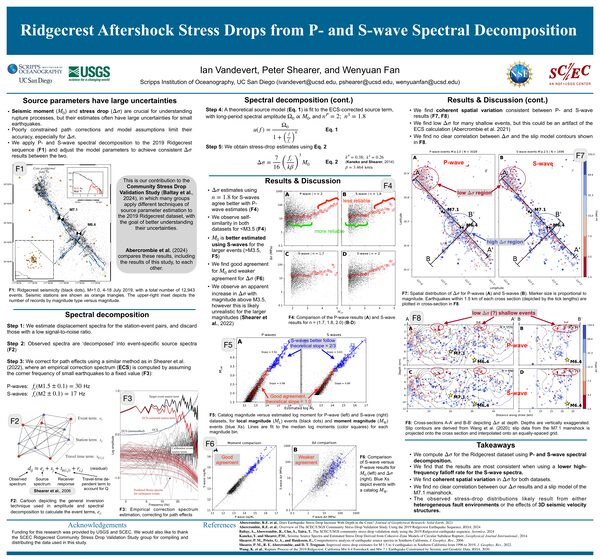
Seismic moment and stress drop are crucial for understanding earthquake rupture processes, but their estimates often have large uncertainties for small earthquakes. Stress drop is typically inferred from an earthquake’s source spectrum based on theoretical models, but poorly constrained path corrections and other modeling assumptions limit the accuracy of stress-drop estimates. Here, we compute stress drops using both P and S waves for the 2019 Ridgecrest earthquake sequence, compare their estimates, and evaluate the associated uncertainties. We use spectral decomposition and apply the analysis to both types of waves for the same set of earthquakes, adjusting some S-wave parameter choices to obtain overall consistency with our P-wave results. Our approach fixes the corner frequency of small calibration earthquakes to reduce scatter in the estimated source parameters of the larger earthquakes. We find that assuming a lower high-frequency fall-off rate for S waves yields more consistent absolute stress-drop estimates between P and S waves. Our stress-drop estimates appear to increase slightly with magnitude for earthquakes with magnitudes >∼3.4. Furthermore, we find that the stress-drop estimates using both types of data exhibit coherent spatial variations. Earthquakes near the Coso geothermal field tend to have lower stress drops, and earthquakes near the M 7.1 hypocenter have higher stress-drop estimates. This spatial pattern is consistently observed in both the P- and S-wave results. We find no strong correlation between our stress-drop estimates and the M 7.1 Ridgecrest earthquake slip distribution, suggesting a heterogeneous stress environment for the Ridgecrest fault system.
@article{vandevert2024ridgecrest,title={Ridgecrest {{Aftershock Stress Drops}} from {{P}}- and {{S}}-{{Wave Spectral Decomposition}}},author={Vandevert, Ian C. and Shearer, Peter M. and Fan, Wenyuan},year={2024},month=nov,journal={Bulletin of the Seismological Society of America},issn={0037-1106},doi={10.1785/0120240133},urldate={2024-11-27},copyright={All rights reserved},file={/Users/ivandevert/Zotero/storage/VRQG4LJE/Vandevert et al. - 2024 - Ridgecrest Aftershock Stress Drops from P‐ and S‐W.pdf;/Users/ivandevert/Zotero/storage/C7KAABIE/Ridgecrest-Aftershock-Stress-Drops-from-P-and-S.html}}